
Pokanoket Voices

The Pokanoket & the Myth of the Empty Land: Uncovering Pre-Colonial New England
The Pokanoket and the Myth of the Empty Land: Discover how archaeology, early European accounts, Indigenous agriculture, and demographic research reveal a densely populated and cultivated southern New England before disease and colonization transformed the region.

The Geography of Survival: Indigenous Kinship & King Philip’s War
Explore King Philip’s War through a Pokanoket and broader Indigenous perspective. This article examines how geography influenced Metacom’s resistance and the different pathways of survival Indigenous peoples followed. It explores how waterways and kinship networks shaped alliances, migration, refuge, and conflict across New England—and how the Pokanoket and other Indigenous communities endured long after the war.

Simeon Simons: Remembering a Pokanoket Patriot
As America commemorates the 250th anniversary of the American Revolution, this article explores the remarkable story of Simeon Simons, an Indigenous Revolutionary War soldier from Connecticut remembered by his descendants as Pokanoket and a descendant of Metacom (King Philip). Simons served in the Continental Army and was remembered in family and local tradition for his association with General George Washington.
Drawing upon military records, local histories, The Narragansett Dawn, and the family history preserved by Simeon's descendant Princess Red Wing (Mary E. Glasko Weeden), the article examines how Pokanoket memory survived the devastating aftermath of King Philip's War through migration, intermarriage, kinship, and adaptation. It also explores how changing government racial classifications often obscured Indigenous identities that continued to be preserved within families.
Simeon's story connects two defining moments in American history: King Philip's War and the American Revolution. Nearly a century after Metacom resisted English colonial expansion, a man remembered within his family as belonging to Metacom's bloodline fought for American independence. His story reminds us that the destruction of Pokanoket political autonomy did not mean the disappearance of the Pokanoket people.
Our story did not end in 1676.

The English Entered A Indigenous World: Borderlands, Diplomacy, and Power in Early New England
Challenges the myth that Indigenous political authority disappeared after Plymouth, demonstrating how the Pokanokets and Narragansetts continued shaping early New England through diplomacy, borderlands, and competing spheres of influence.

Who Speaks for the Past? Indigenous Memory, Survival, and the Pokanoket Question in Southern New England.
Why do different Indigenous communities remember the same history differently? This article explores how war, survival, and colonialism shaped competing memories of the Pokanoket, Wampanoag, Mashpee, and Aquinnah, challenging readers to reconsider who speaks for the Indigenous past.

Aquidneck Island, Ousamequin, and the Problem of Indigenous Borderlands
Who held influence over Aquidneck Island before colonization? This article challenges the idea that the 1638 Narragansett deed settled the question. Instead, it argues that 1638 was the beginning, not the conclusion of our understanding of Aquidneck’s deeper Indigenous history. Drawing on oral tradition, colonial accounts, geography, and modern scholarship, the article explores Aquidneck as a contested Indigenous borderland shaped by the Pokanoket–Narragansett rivalry, the Great Dying, and shifting regional political power.

Pokanoket or Wampanoag?: The Origins of Names
The Indigenous people who first interacted with the Pilgrims in 1621 identified themselves as Pokanoket, not Wampanoag. The widespread use of "Wampanoag" to describe this group is a colonial-era distortion that emerged after King Philip’s War (1675–1678), obscuring the true political and cultural identity of Massasoit Ousamequin’s people.

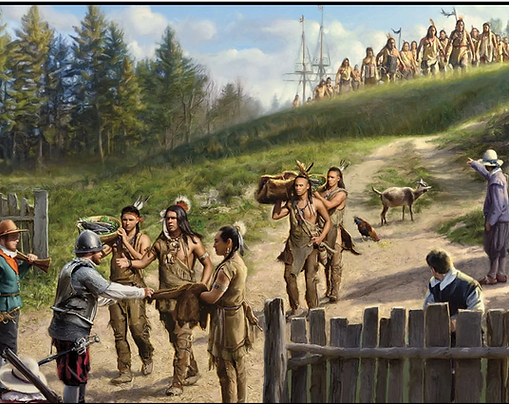
We Were Never Wampanoag: Erasing Pokanoket
This article examines the historical identity of the Pokanoket and the later emergence of “Wampanoag” as a broader regional identity. Drawing on 17th-century records, linguistic scholarship, and Indigenous history, it explores how Pokanoket identity was rooted in territory, kinship, and political sovereignty, and how war, colonization, displacement, and changing historical terminology contributed to the decline of the Pokanoket name in the written record.


The Suspicious Death of Wamsutta: Prelude to War
This article examines the life, leadership, and suspicious death of Massasoit Wamsutta, eldest son and successor of Ousamequin. It explores Wamsutta’s efforts to defend Pokanoket sovereignty, strengthen Indigenous alliances, and resist Plymouth Colony’s growing political control. His arrest and sudden death in English custody in 1662 deepened Pokanoket distrust of Plymouth and became an important prelude to the conflict that erupted thirteen years later as King Philip’s War.


Beyond Recognition: The Pokanoket Land Return and the Power of Survivance
A historic land return to the unrecognized Pokanoket Tribe challenges conventional ideas of justice and recognition. Discover how this act affirms the enduring power of Indigenous identity and "survivance" against centuries of erasure.


Sowams: The Sacred Center of the Pokanoket World
Uncover the true significance of Sowams, not just as a historical settlement, but as the enduring heart of the powerful Pokanoket Confederacy. Learn how modern acts of reclamation are restoring justice and reaffirming the sovereign identity of the Pokanoket Tribe.

Ancestral Fields: Pokanoket Agriculture, the Three Sisters, and Ecological Wisdom
Discover the sophisticated and sustainable agricultural practices of the Pokanoket people, from the "Three Sisters" to their lunar calendar. Learn how their ancestral wisdom offers powerful lessons for today's climate challenges.

The Wetu: Traditional Home of the Northeastern Algonquian Peoples
This article explores the history, design, and cultural significance of the Indigenous wetu, the traditional dome-shaped home used by many Northeastern Indigenous communities including the Pokanoket. Drawing on historical accounts, Indigenous scholarship, and environmental perspectives, the piece highlights how the wetu reflected sustainable living, seasonal stewardship, and a deep spiritual relationship with the natural world.

Massasoit Ousamequin & The Pokanoket Confederation: A Sovereign Indigenous Power
Discover Massasoit Ousamequin, not just a chief, but the leader of the powerful Pokanoket Confederation, a sovereign Indigenous nation that shaped early New England. Uncover how this sophisticated alliance thrived through diplomacy and kinship, challenging colonial narratives of submission.